



Install Steam
sign in
|
language
简体中文 (Simplified Chinese)
繁體中文 (Traditional Chinese)
日本語 (Japanese)
한국어 (Korean)
ไทย (Thai)
Български (Bulgarian)
Čeština (Czech)
Dansk (Danish)
Deutsch (German)
Español - España (Spanish - Spain)
Español - Latinoamérica (Spanish - Latin America)
Ελληνικά (Greek)
Français (French)
Italiano (Italian)
Bahasa Indonesia (Indonesian)
Magyar (Hungarian)
Nederlands (Dutch)
Norsk (Norwegian)
Polski (Polish)
Português (Portuguese - Portugal)
Português - Brasil (Portuguese - Brazil)
Română (Romanian)
Русский (Russian)
Suomi (Finnish)
Svenska (Swedish)
Türkçe (Turkish)
Tiếng Việt (Vietnamese)
Українська (Ukrainian)
Report a translation problem

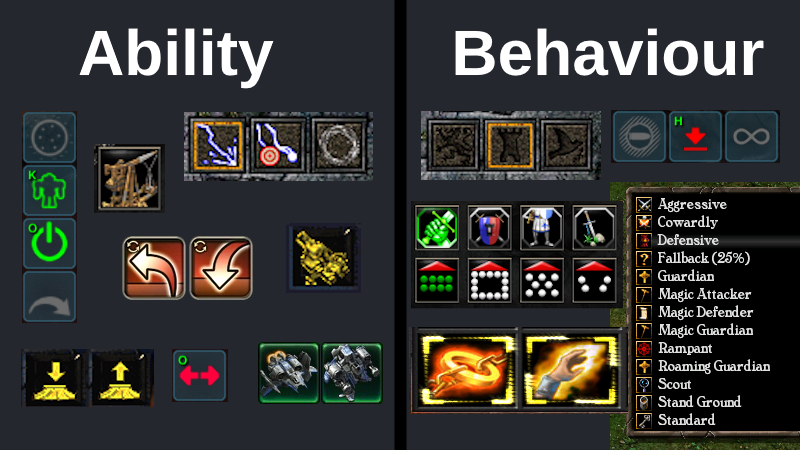 There are broadly two types of state toggle: ability toggles and behaviour toggles. This is a useful distinction despite the fact that, at a fundamental level, everything a unit can do is an ability, and every different way it can choose to do it is a behaviour. In practise there is a often clear difference between controlling a specific ability or generic behaviour, although some toggles end up in between.
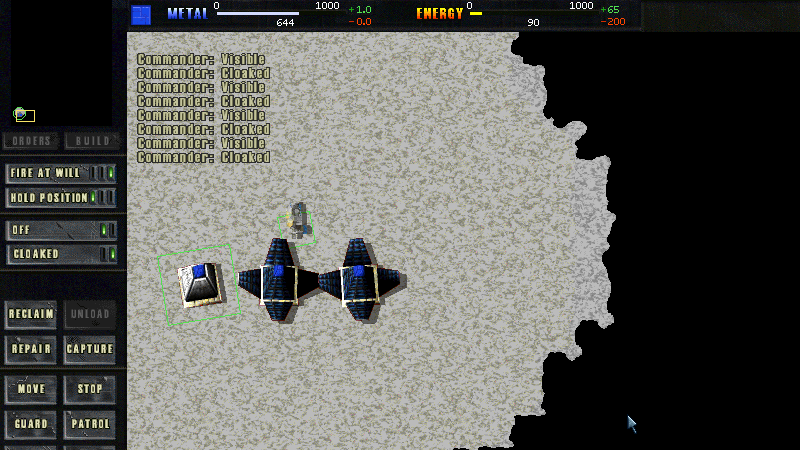 The problem with state toggles is that they are fiddly and are, for the most part, the least satisfying way to control units. Issuing orders, say to set up a flank or to unleash an ability on a group of enemies, is much more fun than fiddling around with buttons tucked into the corner of the interface. Many state toggles have subtle effects, which makes it hard for players to see that their actions had any impact. Seeing the states of units is itself a problem, as there is no good way to fully display the more abstract states. Zero-K fails to show all the different ways a state is toggled in a mixed selection of units, and while there is an option to show states overhead when shift is held, it is very messy so not something we would want to enable.
 Zero-K uses relatively few ability toggles and is a recovering behaviour toggle addict. Our use of ability toggles is curtailed by the idea that state toggles should be as optional as possible. This would seem to rule out many abilities, such as deploying to fire, but strictly speaking it only rules out versions of the ability that require a manual toggle. A toggled ability can have an automatic behaviour provided that toggling is never a bad idea. For example, our deployable units avoid state toggles by having their pack-up times tuned so that deploying is almost never wrong, so they may as well deploy automatically when idle. This restricts our design space, but removing a toggle is worth it.
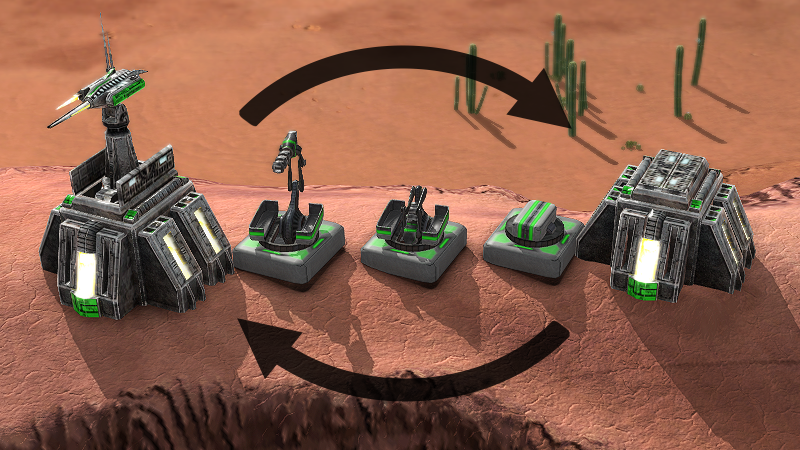 Sometimes a new ability toggle can be avoided by piggybacking on an existing one. For example a handful of light units and turrets can also hunker down to reduce incoming damage, but they do so fast enough for the behaviour to be automatic. Most of the time this lets them use the ability without touching a toggle, and in a situation where the units should stay armoured, they can be set to Hold Fire. The Float/Sink toggle works similarly since, by default, units only float to fire at the enemy. In more extreme cases we redesign units to remove state toggles, or avoid adding a toggled ability in the first place. Raven dive is an example of the former, while shield link is an example of the latter.
 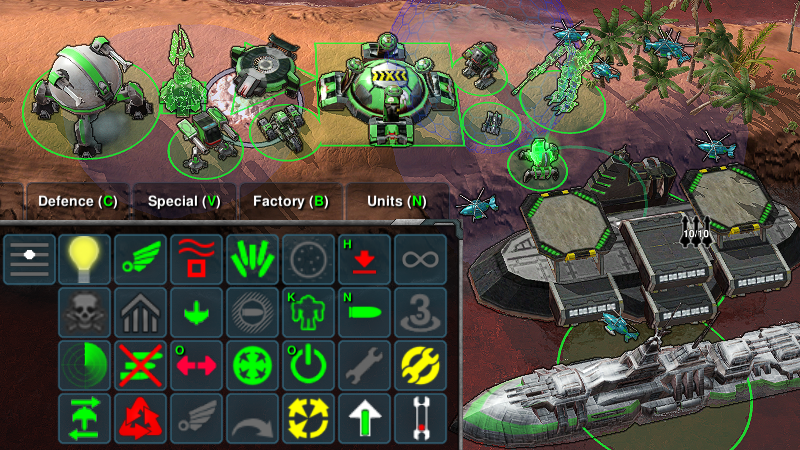 We managed to avoid having too many ability toggles, but went a bit overboard with behaviours. Early on in Complete Annihilation we had many developers adding all kinds of behaviours, so as a form of safety, each of these behaviours got their own toggle. Many of these behaviours were meant to be strict improvements, but we were humble enough to not expect everyone to want the new behaviour. The result was a number of toggles that were designed to never be touched, since the new behaviour should be better, and more flexible, to encompass everything a player might reasonably want their units to do.
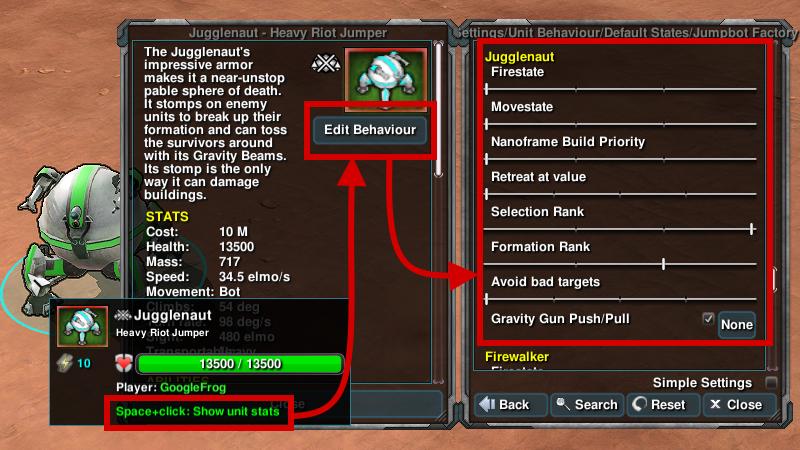 The silver lining to all this state toggle proliferation is unmatched customisation of unit behaviour. Early on we added a section of the menu that lets players set their own default state for each unit type. Some players, including myself, like to set everything to Hold Position, while others set up preset construction priorities to make sure their metal extractors are built as fast as possible. The extraneous toggles that nobody wants to tweak in the heat of battle found their home here. Players can disable various bits of the unit AI on a per-unit-type basis, for every future battle. What started as a mess of widgets, all with their own toggles, ended up being a vast set of options to tweak unit behaviour to your liking.


 Award
Award 2
2


 Introduction to Unit Classes and Factories


 Introduction to Basic Economy
  Anti-Turtle Tactics


 Types of units for the basic factories (Cloak/Shield/Rover)
 A few neato things I discovered







 ...
... 

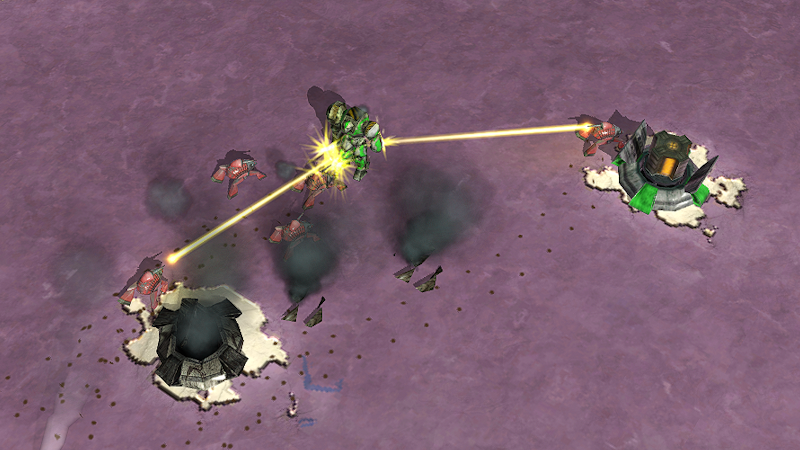 It would take a bit of a redesign to see pure dedicated scouts in the early game. Such a scout would have to be either very cheap or very powerful to offset its drawbacks. This power could be relative, i.e. raiders could become near-blind, but the issue with blind units is that regularly blundering into the enemy feels bad. Ultimately we avoided forcing dedicated scouts into the early game as it would be too much to manage. Remember, monospam is much easier to use than a mix of units, and there is already plenty to do early on without extra complication. We only discovered this relatively recently after adding the Sparrow.
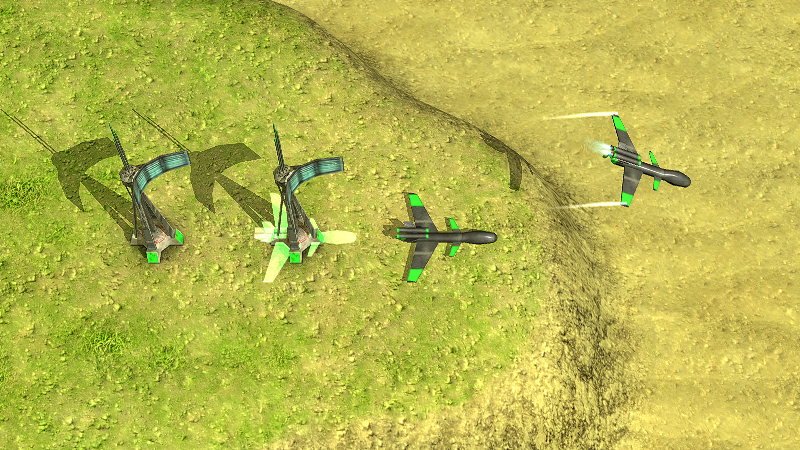 Different types of scouts are good at different types of scouting, and players pick them based on what they want to discover. One type of scouting is "weakness scouting", i.e. scouting to find a crack in the enemy's defence. Raiders are particularly good weakness scouts because they are equipped to follow up on the weaknesses they find. Another type of scouting is "threat scouting", in which players seek to reveal and preemptively counter enemy plans. In fact the cheapest dedicated scout in Zero-K is a threat scout: the Radar Tower. It is perhaps a little weird to call a structure a scout, but I would also call the Starcraft Comsat Station a scout.
 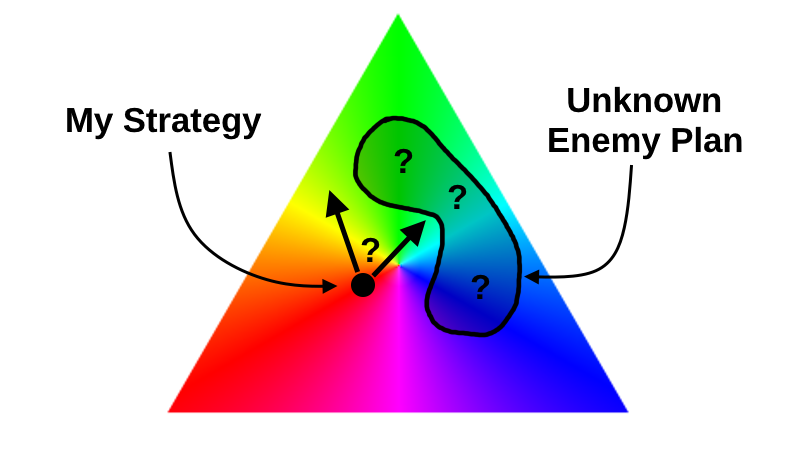 The nature of threat scouting changes over the course of a game, with the main distinction being how early the threats are revealed. All plans are revealed eventually (such as when the nuke launches), but plans that take longer to implement can be revealed earlier than others. Threat scouting for long-term plans is a big part of the dance around the strategic triangle as it is hard to counter your opponent without knowing what they are up to.
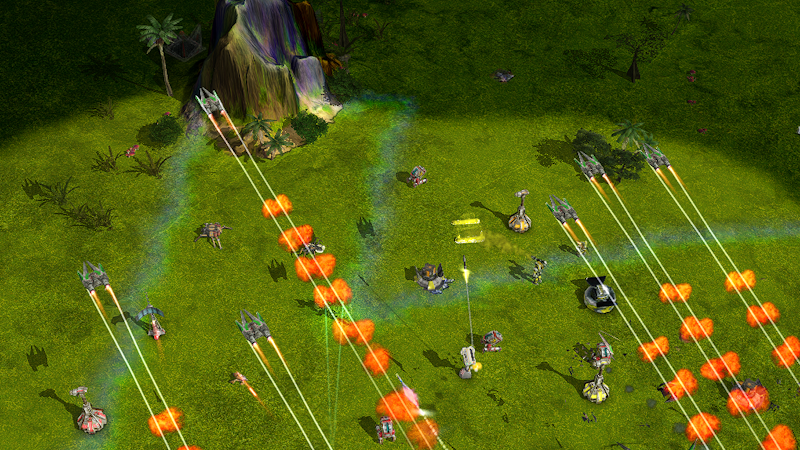 A limit to how little it should cost to scout was found with the discovery of flying Flea scouting, which involved launching Fleas into space with a cheap Newton launcher. Landing was a non-issue because line of sight was cylindrical at the time, so the Flea just had to fly high over the map to reveal a whole swathe of the enemy base. This tactic was far cheaper than other options, so we nerfed it by reducing the sight range of high-flying ground units. Scouting via flying Flea is still possible, but they need to be shot low and fast to see anything, which requires a more expensive launcher and gives the enemy a chance to shoot them down.
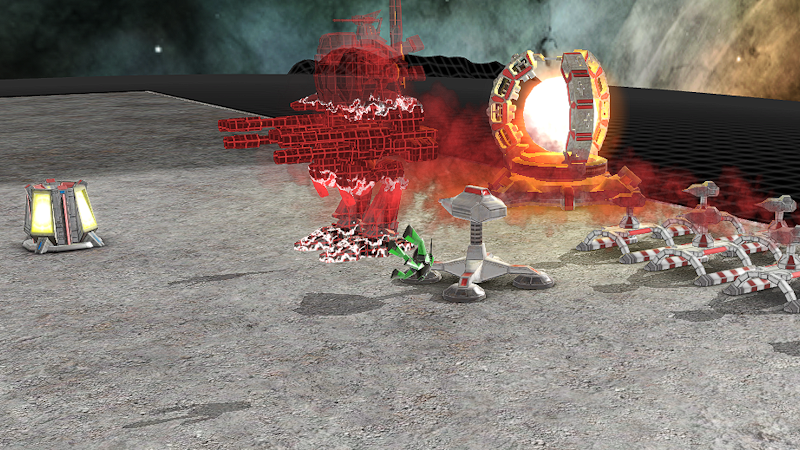 Scouts revealing themselves creates a weird situation when trying to determine which factory the enemy picked. You might spot the factory, or a unit from the factory, but the scout you send is guaranteed to give away your own factory. There are a few ways to get around this, such as with Sparrow, but they are impractical early on. In a 1v1, being scouted is the only reliable way to learn the enemy factory without revealing your own. Scouting and raiding is otherwise important enough for this to not be a concern though, and perhaps the interaction is not that unusual. Most multiplayer games reveal faction choice in the lobby, but some have a hidden random faction option which is only revealed when they scout. So the situation in Zero-K is more a result of factory choice (which is effectively your faction) being hidden by default.
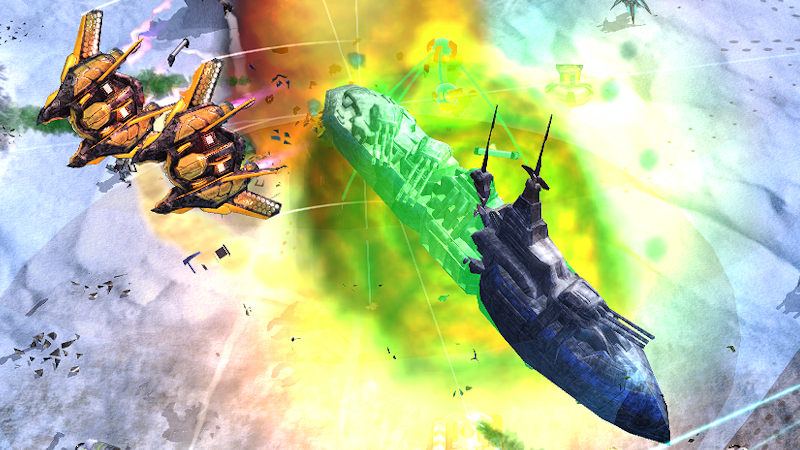 This release is mainly about tweaking a few overused units. Venom is slightly worse at stunning to counteract the overstun change, and other Spiders were buffed to compensate. Lobster now gives the enemy a little more time to react and Magpie should be easier to scare away. Terraform is also UI-nerfed against Missile Silo, as the Force Fire UI now warns you about unintended terrain interactions.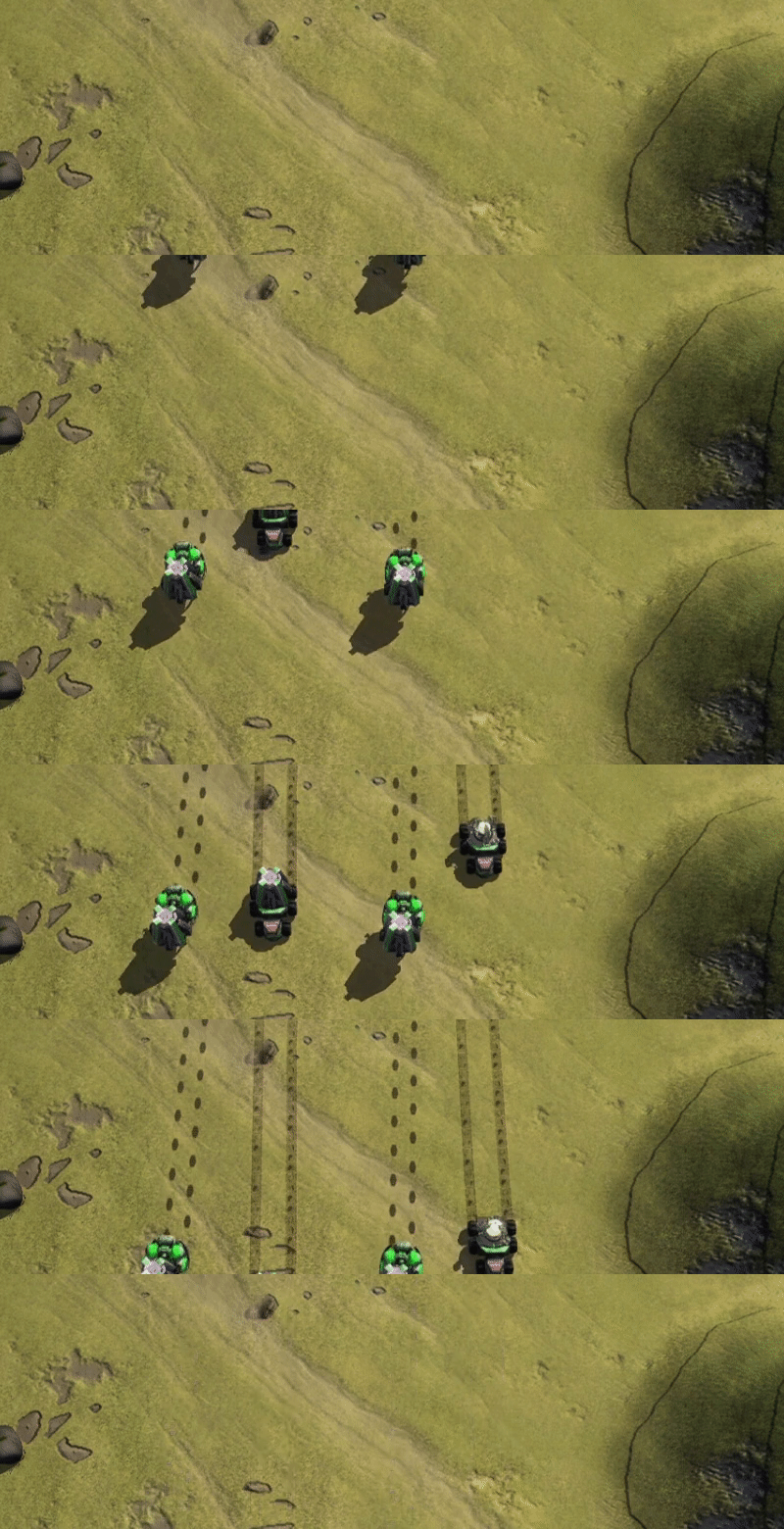

 Loading

